
Delayed Hemiplegia and Posterior Cerebral Artery Infarction in Kernohan-Woltman Notch Phenomenon: Case Report and Literature Review
Keywords:
Kernohan-Woltman Notch PhenomenonAbstract
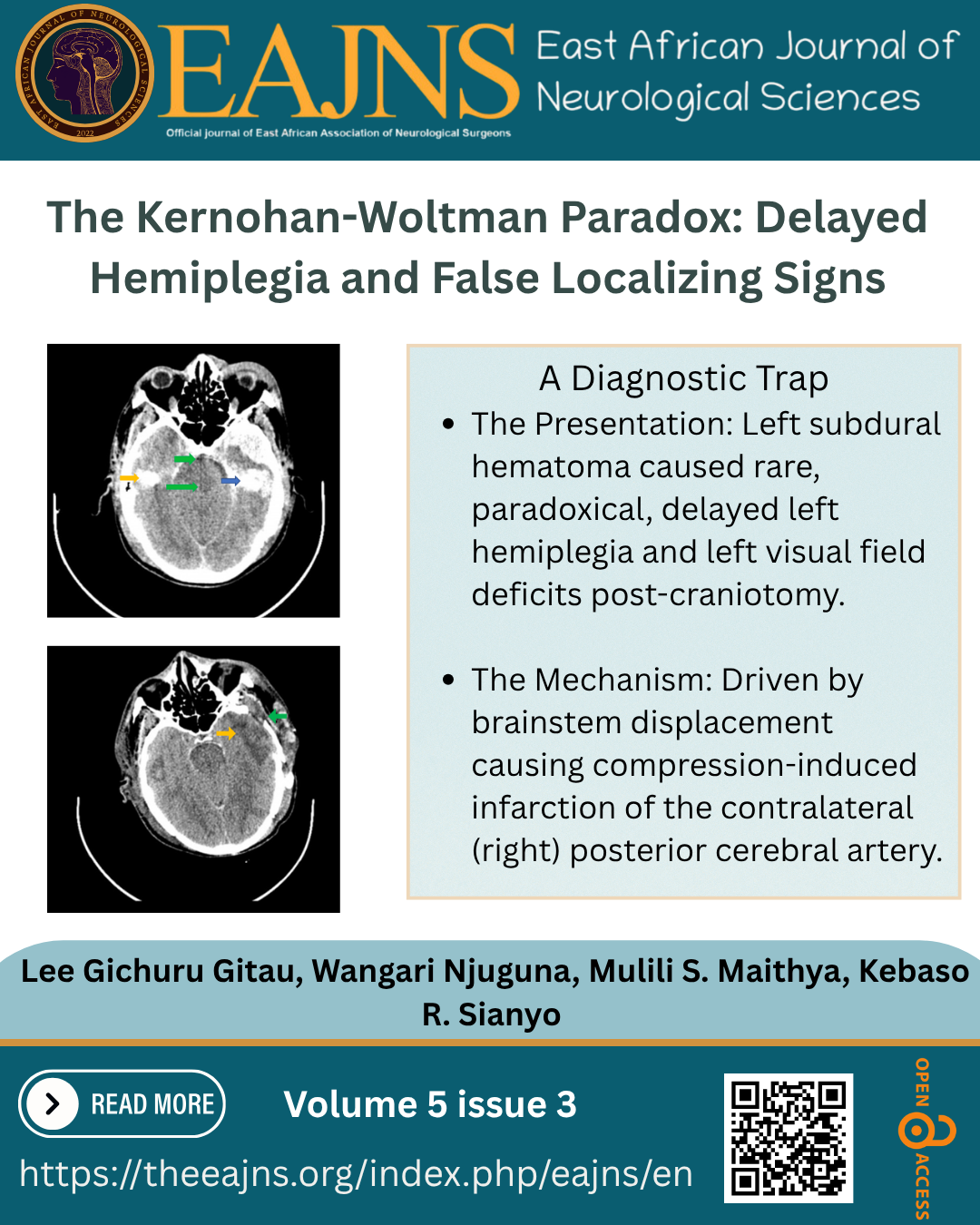
Background: Kernohan-Woltman Notch Phenomenon (KWNP) causes ipsilateral mydriasis and paradoxical ipsilateral hemiparesis or hemiplegia. Delayed ipsilateral hemiplegia and infarction of the posterior cerebral artery (PCA) are rare manifestations of KWNP. Case summary: A 42-year-old man presented with loss of consciousness after an accident. His GCS was 10/15. He was anisocoric with left-sided mydriasis, and had hypertonia and hyperreflexia in the left lower and upper limbs with normal tone and reflexes in the right limbs. A computerized tomography (CT) scan showed an acute left subdural hematoma with midline shift. After craniotomy, he developed hemiplegia (Medical Research Council [MRC] grade 0/5) on his left upper and lower limbs. He also developed an “inability to see” from his left eye. He was discharged 4 weeks later with a GCS of 15/15 and power of MRC grade 5/5 on his right and left upper and lower limbs. Investigations: A pre-operative CT scan revealed an acute left subdural hematoma and midline shift. A post-operative CT scan revealed a contralateral (right) PCA infarct. All laboratory tests conducted were normal. Outcome/Interpretation: The patient had an acute left subdural hematoma with midline shift. The subdural hematoma also caused KWNP with delayed hemiplegia and contralateral (right) PCA infarction, which caused visual changes. Conclusion: KWNP may cause delayed hemiplegia. This presentation may also be accompanied by infarction of the contralateral PCA, causing visual changes. Recognizing this presentation is crucial in diagnostic formulation for hemiplegia and visual changes occurring after decompressive craniotomy. MRI may be useful in diagnosing KWNP and differentiating it from a primary brainstem hemorrhage.
Downloads
References
1. Beucler N, Cungi PJ, Baucher G, Coze S, Dagain A, Roche PH. The Kernohan-Woltman Notch Phenomenon : A Systematic Review of Clinical and Radiologic Presentation, Surgical Management, and Functional Prognosis. J Korean Neurosurg Soc. 2022 Sept;65(5):652–64.
2. Laaidi A, Hmada S, Naja A, Lakhdar A. Kernohan Woltman notch phenomenon caused by subdural chronic hematoma: Systematic review and an illustrative case. Ann Med Surg. 2022 June 14;79:104006.
3. Naik A, Bederson MM, Detchou D, Dharnipragada R, Hassaneen W, Arnold PM, et al. Traumatic Brain Injury Mortality and Correlates in Low- and Middle-Income Countries: A Meta-Epidemiological Study. Neurosurgery. 2023 Oct 1;93(4):736–44.
4. Cholo W, Odero W, Ogendi J. The Burden of Motorcycle Crash Injuries on the Public Health System in Kisumu City, Kenya. Glob Health Sci Pract. 2023 Feb 28;11(1):e2200197.
5. Gesaka SR, Okemwa PM, Mwachaka PM. Histological types of brain tumors diagnosed at the Kenyatta National Hospital between 2016 and 2019: a retrospective study. Discov Oncol. 2024 Feb 18;15:39.
6. Ahmed F, Shamim MS, Ali SA. Kernohan–woltman notch phenomenon:Case report and Review of literature. 2017;12.
7. Murhega RB, Balemba Ghislain M, Mudekereza PS, Musilimu S, Bisimwa I, Munguakonkwa Budema P, et al. Kernohan–Woltman notch phenomenon in patient with subdural hematoma and ipsilateral hemiparesis in Bukavu. Clin Case Rep. 2023;11(7):e7643.
8. Chauhan K, Brooks JT, Oyawusi M, Weir R. Possible presentation of Kernohan–Woltman notch phenomenon in a young female with heavy drinking: a case report. Egypt J Neurol Psychiatry Neurosurg. 2024 Dec 2;60(1):142.
9. Negrão C, Silva MC, Machado M, Mourato M, Chumbo C, Tomás AR, et al. Kernohan-Woltman Notch Phenomenon: A Case of Paradoxical Hemiparesis. Cureus [Internet]. 2025 Jan 6 [cited 2025 Oct 21];17. Available from: https://cureus.com/articles/314012-kernohan-woltman-notch-phenomenon-a-case-of-paradoxical-hemiparesis
10. Lin Y, Chen-Lung Chou A, Lin X, Wu Z, Ju Q, Li Y, et al. A case of Kernohan-Woltman notch phenomenon caused by an epidural hematoma: the diagnostic and prognostic value of PET/CT imaging. BMC Neurol. 2022 Nov 10;22(1):419.
11. Pereira CU. Kernohan-Woltman Notch Phenomenon—Case Report. Arq Bras Neurocir Braz Neurosurg. 2016 Dec 5;38:56–9.
12. Harnold SP, Gazali S, Musadir N, Fadhila L. Kernohan-Woltman notch phenomenon in traumatic brain injury patient: A case series. J Neurol Sci [Internet]. 2023 Dec 1 [cited 2025 Oct 21];455. Available from: https://www.jns-journal.com/article/S0022-510X(23)02201-3/fulltext
13. Simonin A, Levivier M, Nistor S, Diserens K. Kernohan’s notch and misdiagnosis of disorders of consciousness. BMJ Case Rep. 2014 Feb 15;2014:bcr2013202094.
14. Moon KS, Lee JK, Joo SP, Kim TS, Jung S, Kim JH, et al. Kernohan’s notch phenomenon in chronic subdural hematoma: MRI findings. J Clin Neurosci Off J Neurosurg Soc Australas. 2007 Oct;14(10):989–92.
15. Hilario A, Ramos A, Millan JM, Salvador E, Gomez PA, Cicuendez M, et al. Severe Traumatic Head Injury: Prognostic Value of Brain Stem Injuries Detected at MRI. AJNR Am J Neuroradiol. 2012 Nov;33(10):1925–31.
16. Pastor IS, Para I, Vesa ŞC, Florian IŞ. The impact of oral anticoagulants on the characteristics of subdural hematomas and other brain lesions in patients with traumatic brain injury. Med Pharm Rep. 2023 July;96(3):269–73.
17. Iyer A, Killian M, Stead TS, Mangal R, Ganti L. Acute-on-Chronic Subdural Hematoma Secondary to Falls Due to Alcoholism. Cureus. 14(9):e29503.
18. Haddadin F, Munoz Estrella A, Herzog E. Hypertensive emergency presenting with acute spontaneous subdural hematoma. J Cardiol Cases. 2018 Oct 16;19(1):25–8.
19. Cho S, Rehni AK, Dave KR. Tobacco Use: A Major Risk Factor of Intracerebral Hemorrhage. J Stroke. 2021 Jan;23(1):37–50.
Downloads
Published
License
Copyright (c) 2026 East African Journal of Neurological Sciences

This work is licensed under a Creative Commons Attribution-NonCommercial-NoDerivatives 4.0 International License.


